Affinity Photo Trial Mac Download
Designed from the ground up to enable you to edit, process and transform your photos with the help of its comprehensive set of features and tools
Download Affinity Photo for Mac - Designed from the ground up to enable you to edit, process and transform your photos with the help of its comprehensive set of features and tools. April 3, 2020 Trial. Review Free Download specifications 100% CLEAN report malware. Download the latest version of Affinity Photo for Mac - Digital editing for photographers and bitmap artists. Read 68 user reviews of Affinity Photo on MacUpdate. If you visit the developer's web site, rather than the App Store, you can download a trial version and give it a test drive. I recommend doing so. Jun 30, 2020.
What's new in Affinity Photo 1.8.4:
- Various stability and performance improvements
Aimed at professional photographers and other visual artists, Affinity Photo is a comprehensive and multi-platform software solution for powerful photo editing that offers an interesting alternative to other more expensive and more popular similar apps.
Keeping in mind that most fully featured photo processing apps are not what you would call resource friendly, Affinity Photo’s takes on a different approach and focuses on performance and speed, a fact that becomes obvious from the first minutes you start using it.
Everything is done with the help of the app’s five “Personas”
You interact with Affinity Photo with the help of five built-in design environments, named “Personas”: Photo, Liquify, Develop, Macro, and Export. The Photo Persona will probably the most used mode because it features all the main tools needed for basic photo editing tasks, while the Liquify Persona bundles a couple of special warping effects and useful retouching tools.
The Develop Persona is designed with RAW photo processing in mind and it provides you with full control for adjusting your image’s tones and colors, the Macro Persona is specially useful for building and applying macro presets, while the Export Persona, as its name clearly suggests, makes it easy for you to export your images, layers or image slices to a wide variety of formats.
Well organized, but not without faults, user interface
Build to be a valid alternative to other fully featured photo editors, Affinity Photo’s interface doesn’t stray from the common layout with applications of this kind, and, therefore, its majority of features can be easily accessed from the panels found in the extreme left and right sides of its main window.
Regarding its interface, the only downside would be the fact that it bundles very small buttons, which, on the long run might decrease your productivity rate, as well as annoy you at times, especially if your have a Mac with a Retina display.
Bundles a plethora of useful and powerful photo editing tools
As expected, the software enables you to work with overlays and to perform basic adjustments (clarity, contrast, exposure, shadow, highlights, vibrance white, balance, detail refinement, noise reduction, noise addition), as well as to correct the lens’ distortions and chromatic aberrations.
Furthermore, Affinity Photo helps you work with layers and perform complex layer related operations, perform retouching effects, use filters and effects from its large collection, as well as perform local adjustments with the help of its versatile brushes.
All in all, Affinity Photo proved to be a fast and powerful photo editing solution for the vast majority of Mac users, but we will probably see a lot more additions, further improvements and enhancements in the near future.
Filed under
Affinity Photo was reviewed by Vladimir Ciobica- 10 days trial
- 64-bit processor
- Intel 64-bit Core 2 Duo or better (from 2007)
- 2 GB RAM minimum
- 780 MB of available space; more during installation (cannot be installed on removable flash storage or a volume with a case-sensitive file system; additional space is required to edit images)
- 1280x768 display size or better (supports regular, retina, and expanded gamut DCI-P3 displays)
Affinity Photo 1.8.4
Softpedia Editor's Pickadd to watchlistsend us an update- runs on:
- OS X 10.9 or later (Intel only)
- file size:
- 568.8 MB
- filename:
- affinity-photo-1.8.4.dmg
- main category:
- Graphics
- developer:
- visit homepage
top alternatives FREE
top alternatives PAID
Price: Free Trial or $49.99
VERDICT: You can improve your photos in Serif Affinity Photo software, giving them a professional finishing. But mind that this is not a simple program for beginners.
Nero 2015 serial number keygen. Affinity Photo resembles Adobe Photoshop. Their interfaces and tools layout are similar but at a lower cost, which pleases many beginners. However, when it comes to advanced photo manipulation capabilities, Adobe Photoshop is still a leader.
- Cheaper than Adobe products
- Multilevel photo editing
- Panorama, HDR merge, macro support
- Support RAW files
- Works with raster and vector images
- Layers editing
- No import and photo management tools
- No correction based on lens profile
- Not as professional as Photoshop
Affinity Photo is a British photo editor that is similar to Photoshop and Corel PaintShop Pro. It isn’t a software for photo importing or organizing, it's rather a good choice for image retouching, photo merging for panoramas, making a HDR effect, and basic digital drawing.
However, all programs have certain drawbacks, and Affinity Photo is no exception. I don’t like that such advanced tools as tone mapping or panorama blending are rather slowly and are inferior to Photoshop.
In addition, some of the algorithms should be improved, for example, the one that manages the adjustment layers of shadow and highlight. Graphpad prism mac download crack. It seems that Photoshop can get more detail from shadows and highlights than Affinity Photo.
Affinity Photo Review: Desktop Version
Affinity Photo has all the basic photo editing tools you can expect: red-eye removal, cropping, selecting, drawing tools, as well as instruments for creating vector shapes. It also includes more advanced tools, such as clone stamp, batch edit, font effects, and lens distortion correction.
Modern User Interface
Affinity Photo’s interface is divided into separate task-oriented workspaces, called personas. This means that you will see only icons related to what you are working with. As in Photoshop, the interface has the toolbar on the left, the top panel and context toolbar at the top, and all the corresponding panels at the right. There are 25 panels, which you can add as you wish.
A useful feature that Affinity offers is the Assistant button. It appears at the top of the interface as a tuxedo icon. When you click on it, you can create presets for specific tools. For example, you can set it up so that when you click on the Brush tool, the Assistant automatically optimizes the layer type and applies the specified tool parameters.
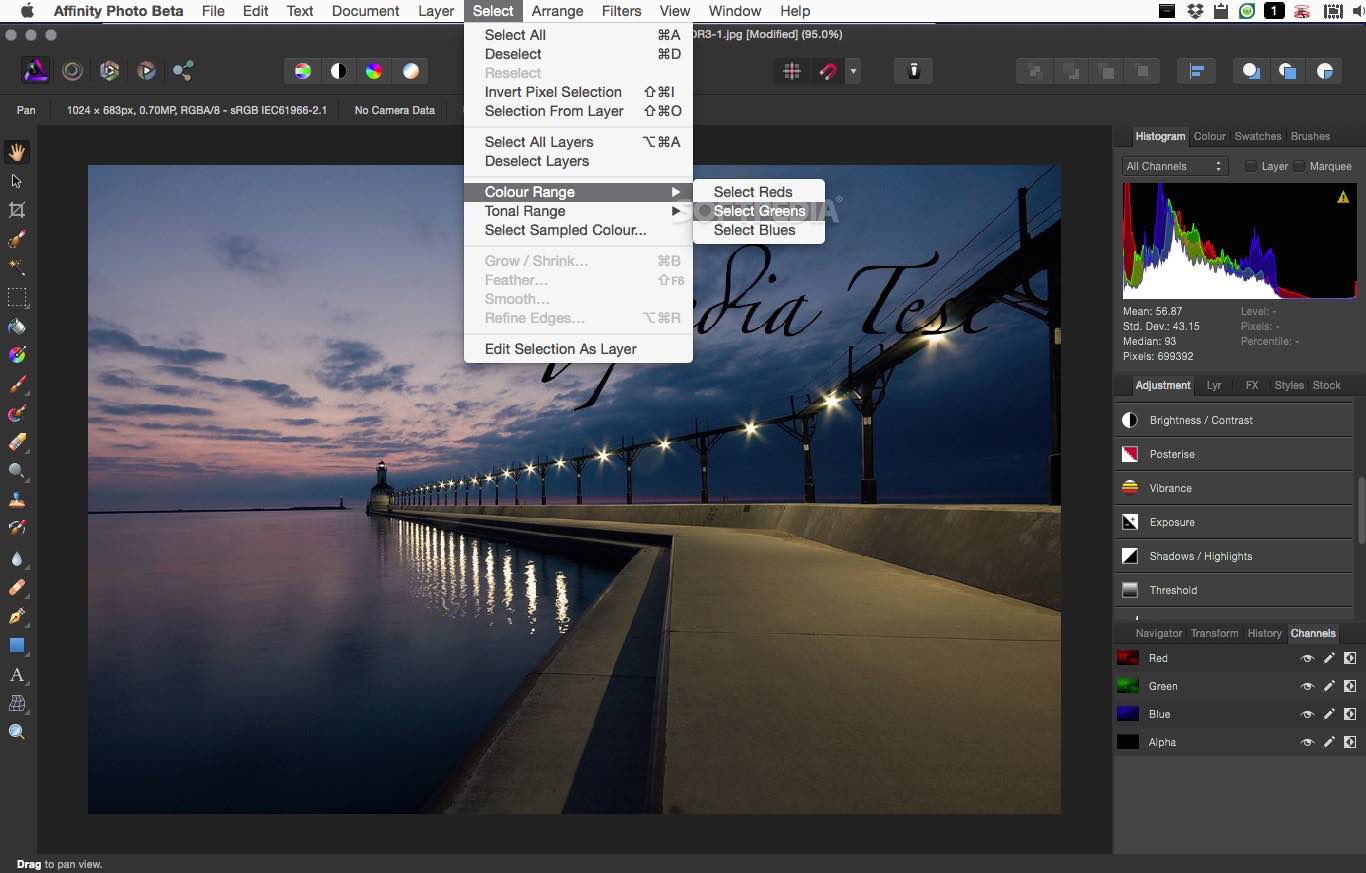
Photo Editing Workflow
This is the photo I edited in Affinity Photo for about 30 minutes. Affinity Photo editor can’t become a full-fledged alternative, such as Capture One Pro, because it is not intended for integrated system organizations. You can view image files on your computer, but there is no advanced image search function or ranking system. This means you will spend more time searching for a particular image using Affinity Photo.
This software has a separate photo organizing application. The editor is compatible with RAW, JPG, TIFF, PNG, GIF, PSD, PDF files and many others. However, I do not quite like the fact it does not support animation files. It means you can’t create animated GIF files in this image editor.
Affinity Photo offers non-destructive photo editing, RAW processing, and real-time tools. All this make the image editor very useful for photographers. The most unusual feature frequently discussed on Affinity Photo forum is the division of the image post production into personas. Each one is responsible for its own set of functions and allows not to overload the interface. There are four of them:
Photo Persona - Basic tools for image editing.
Liquify Persona – Allows to modify the image grid using tools specifically designed for liquify changes.
Develop Persona - Opens by default when you process RAW image files and can be switched from raster layers. It includes tools that allow users to customize the tone and overall look of the image.
Export Persona - This area gives users more precise control over the output of the image.
- View moreAdobe Illustrator alternatives.
Develop Persona
Develop Persona in Affinity Photo editor has all exposure and lens correction settings that we expect on the “Basic”, “Lens”, “Details”, “Tones”, and “Overlays” panels. Exposure, Vibration, Shadow and Glare, Cleaning, Sharpening. All this is present there and even more. /goodnotes-for-mac-free-download.html.
You can save a set of changes to a profile for faster photo editing, and then apply the profile with one click.
To control any exposure settings in Affinity Photo Photoshop free alternative, you can use the function for cropping bright areas/shadows and tones, which adds any tonal spikes to the image. There is also a histogram, along with any EXIF data that includes a location map, if this information is available.
There are instant previews of any changes made. I like the split-screen and mirror screen options which show the before and after image editing effect.
Photo Persona
By default, image editing is performed in non-destructively way through adjustment layers. Each layer can be selected, deselected and deleted individually or blocked as a group for further photo editing. I think this is a more intuitive method than making changes with the help of the Story panel.
Speaking about Affinity Photo Persona, you will have access to a combined group of tabbed panels on the right side of the image editor’s window. The top tab will show a histogram, color sets, patterns and brushes, curves, LUTs, and gradients. The bottom panel contains a photo navigator and sections with “Channels” “Transformation” and “History”.
As a rule, in this mode, everything is done automatically, including white balance, contrast, and other settings. However, you can always correct everything manually in the right-side panel of the photo editor. The “Correction” panel includes most of your edits, from levels and curves to vibration and HSL (hue, saturation, brightness). When you click one, it is added as a new adjustment layer with a pop-up window containing controls for setting.
Look at the filters. Affinity Photo includes many filters to create blur effects, distortion, noise, etc. They are applied to the pixel layer and, at the same time, the pixels on this layer are changed (editing it destructively). Many of these filters are available as Live Filter layers, which act as adjustment layers. It means you can make independent changes and reconfigure them later.
Liquefy & Tone Mapping Personas
All Affinity Photo reviews state that Liquefy is a powerful tool using which you can stretch and deform an image with any deformation style. The grid is overlaid to show the shape of the base that was used. Tone Mapping is like an HDR tool with many presets that can be applied directly to an image.
Liquefy and Tone Mapping Personas are very effective. It means you will spend less time using these tools. Not many photographers will apply them every day, however, you must be extremely gentle and neat with these tools to avoid unnatural-looking faces.
Advanced Selection Tools
Affinity Photo selection tools are rather predictable — “Rectangular”, “Elliptical”, “Free Hand” (Lasso), “Stream Selection” (Magic Wand) and the Selection Brush tools. I was very impressed with the minimum efforts required to refine the selection. For example, I expected that it would take more effort to clear the selected hair in the portrait, but all I had to do was pressing the “Refine” button and painting the edges.
In addition to the basic options, Affinity Photo Photoshop alternative has several other powerful tools. Tone Mapping copes with merging exposures for HDR photos (with high dynamic range). However, I don’t like that sometimes it works a bit incorrect.
If you are editing portraits in Affinity Photo Windows or Mac, the frequency separation function simplifies the processing of parts of a picture without losing their texture. Command selecting splits the pixel layer into two separate layers – high and low frequency. Coloring the areas that need to be smoothed on each layer softens the skin (low-frequency layer), while preserving texture details (high-frequency layer).
Text and Typography
One of the most interesting features that I can’t but mention in my Affinity Photo review is that you can easily open PSD files from Photoshop. However, I came across a problem after testing several options. Working with the text in the program, you can resize, move the text window, but not edit the text itself.
The program has its text tools, Artistic Text, and Frame Text. The first is designed to display the type and the second one is needed for longer inscriptions. Very detailed formatting with thousands of OpenType fonts is at your disposal. You can manage ligatures, but you don't get the same level of editing as Illustrator offers.
Comfortable Work with Masks
In my opinion, Affinity Photo offers more convenient work with masks, acting as independent layers. Adjustment layers are made in the form of presets. The photo processing history is stored in the file itself. It means you will easily transfer the project to another person who will understand it with ease. Actually, I noticed lots of such pleasant nuances when I started to review Affinity Photo.
Photo Merge Tools
Not all shooters take 360-degree photos. However, with the increasing popularity of action cameras and the growth of virtual reality, this may be something that you will use in the future. That’s why having a certain space for image editing, you can move/zoom when editing 360-degree photos. A set of powerful will be also of great help.
The HDR merging allows you to bring the best details from multiple exposures into one photo. In Affinity Photo HDR merger you can select an unlimited number of source images and automatically align them before merging into one picture. Keep in mind that this is a very resource-intensive task, which will probably take a few minutes if your computer is not very powerful.
Photo Export
Export Persona in Affinity Photo Windows and Mac allows you to create fragments of images. You can export your works in PNG, JPEG, GIF, TIFF, PSD, PDF, SVG, WMF or EPS formats. Please note, you cannot export in Illustrator format.
While exporting, it is possible to export multiple versions of one file simultaneously with independent control of renaming files and resizing images. There is also a wide selection of file types for export.
I couldn’t find a renaming function while doing batch photo processing. This is a bit disappointing. You can also set the width or length in pixels for a batch. However, there is no option for the longest dimension in pixels that can be used for landscape and portrait orientation.
Affinity Photo Review: iPad Version
One of the most interesting Affinity Photo editions is a mobile version created for the iPad. It allows you to use most of the photo editing functions presented in the full version, turning your iPad into a drawing tablet.
Unfortunately, there is no similar version for Android tablets, and Serif does not announce plans to design it. The application requires iPad Air 2, iPad 2017 or any of the iPad Pro options.
Price
Affinity Photo is available in Mac App Store, Microsoft Store as well as on the official Affinity website. One-time Affinity price is $49.99. There is also a simplified version for iPad for $19.99.
Affinity Photo Download For Mac
Similar Products
- Rank:Developer: Adobe
- Rank:Developer: Adobe
- Rank:Developer: Autodesk Inc.
- Rank:Developer: Autodesk Inc.
- Rank:Developer: TGDT
Affinity Photo Free Download Mac
Ann Young
Affinity Designer Free Trial Mac
Hi there, I'm Ann Young - a professional blogger, read more