P5 Js Download For Mac
By Allison Parrish
In this tutorial, I’m going to take you through Paolo Pedercini’sp5.play library. This is a veryopinionated introduction, and it leaves out a lot of the functionality thatmakes p5.play interesting! Be sure to consult the officialexamples and (referencedocumentation)[http://p5play.molleindustria.org/docs/index.html] to get a senseof everything that the library can do.
- Im trying to compile my own version of the old p5.js desktop editor but is an absolute headache, due to the fact that it is abandoned and some of the dependencies no longer exist. The reason for doing this is that is a great tool for teaching kids and yung people without the troubles of a web editor (internet conecction issues mainly).
- Download this app from Microsoft Store for Windows 10, Windows 8.1, Windows 10 Mobile, Windows Phone 8.1, Windows 10 Team (Surface Hub), HoloLens. See screenshots, read the latest customer reviews, and compare ratings for JavaScript Studio.
- P5.js a JS client-side library for creating graphic and interactive experiences, based on the core principles of Processing.
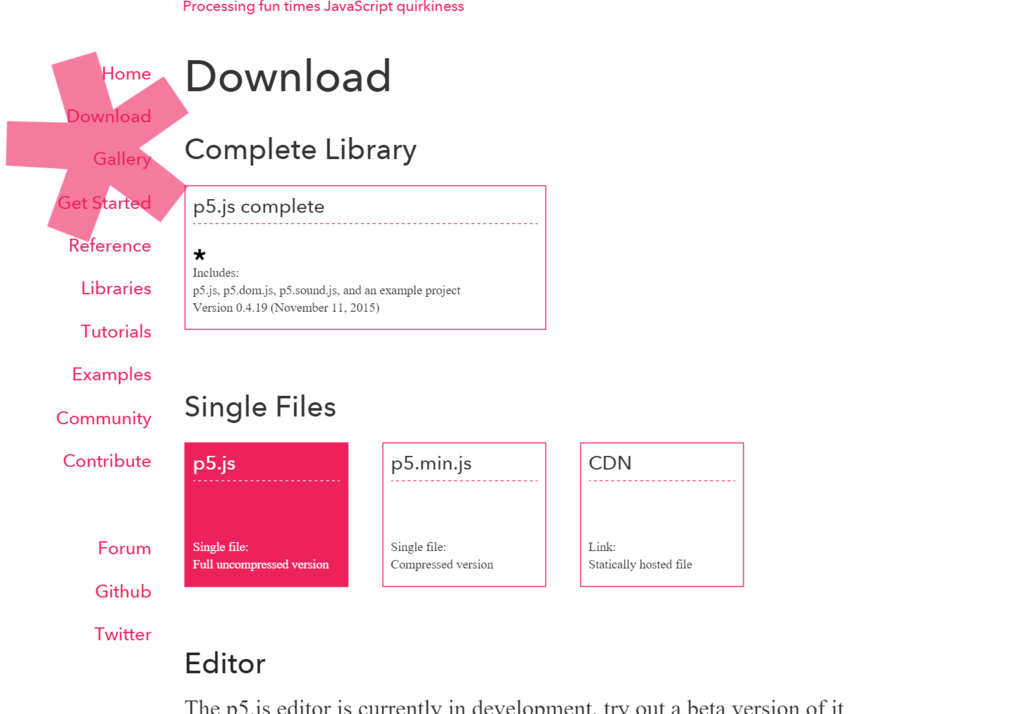
This is a download containing the p5.js library file, the p5.sound addon, and an example project. It does not contain an editor. VisitGet Started to learn how to setup a p5.js project. P5.js complete. Includes: p5.js, p5.sound.js, and an example project Version Single Files.
The p5.play library provides a number of helpful objects and functions formaking games and other interactive applications. The objects and functions itintroduces are incorporated into p5.js just as though they were pre-programmedin the library.
Installation
Download the libraryhere. Unzip thearchive. You’ll find a directory in the archive called lib; copy thep5.play.js file from that directory into your own sketch’s librariesdirectory. Make sure to add the necessary <script> tag to your sketch’sindex.html file as well. (More information here about installing externallibraries when using the p5.js editor.)
Sprites
P5 Js

A “sprite” is an object in a game (or other interactive application) that knowsits own size and position on the screen. Sprite objects typically expose aninterface that allows the programmer to change the sprite’s position,trajectory and appearance, and to allow the programmer to easily ask questionsabout the sprite, such as if it intersects a particular position (or anothersprite). https://teacherbrown230.weebly.com/blog/cox-tv-connect-download-mac.
A single sprite
Creating a sprite in p5.play is accomplished using the createSprite()function. This function returns a sprite object, which itself has a number ofattributes and methods that allow us to query and change properties of thesprite.
Here’s a simple example that creates a single sprite:
The createSprite() function takes four parameters: the position of thesprite, and its width and height. The .shapeColor attribute sets the color ofthe rectangle that represents the sprite. In order for p5.play to display thesprite, we need to add the drawSprites() function to the end of draw().
P5 Js Library
Every sprite has a position attribute and a velocity attribute. Both ofthose attributes have x and y attributes, which you can set to control theposition of the sprite and its velocity (in both dimensions). The p5.playlibrary takes care of updating the position according to the velocity foryou—you don’t have to do any of the math. In the example above, thesprite is constantly moving downwards, unless you click the mouse, in whichcase the sprite is instantly moved to the mouse position.
Sprites on the move
As mentioned above, you can set the sprite’s velocity directly with.velocity.x and .velocity.y. You can also call the sprite’s setSpeed()attribute to tell the sprite to move in a particular direction at a particularrate. In this example, use the arrow keys to control the sprite:
(The key variable in p5.js only works for alphanumeric characters. In orderto detect the arrow keys, we need to use thekeyCode variable.)
Adding gravity to your sketch is as easy as adding a constant downward force onevery frame (using the .setSpeed() method). Here’s an example that causes asprite to be drawn to the screen, which moves downward on every frame and thenbounces when it reaches the bottom:
Following the mouse
There are a number of ways to make a sprite follow the mouse. The first is toset the position directly:
You can also add a bit of lag to the sprite’s movement by setting the X and Yvelocity to the difference between the sprite’s position and the mouse’sposition:
Finally, you can use the .attractionPoint() method to set a force that pushesthe sprite in the direction of the mouse’s position:
In this example, we also set the object’s .maxSpeed attribute (which controlshow fast a sprite can move, regardless of the forces operating on it), its.friction attribute (which is a multiplier that slowly reduces the velocityof the object on each frame), and the .rotateToDirection attribute (which,when set to true, causes the object to rotate to the direction it’s moving).
Examples follow, more narrative notes TK!
Mouse events
Sprites in the p5.play framework come with a built-in mechanism for detectingwhether or not the user is interacting with the sprite using the mouse.There are two ways to check for mouse interaction: callbacks or booleanattributes.
There are four attributes of a sprite object that you can assign functions toin order to define the sprite’s behavior in relation to the user’s mousemovement. The following example illustrates all four:
The four attributes are:
onMouseOver(when the mouse cursor moves over the object)onMouseOut(when the mouse cursor leaves the object)onMousePressed(when the user presses the mouse button, and the mousecursor is over the object)onMouseReleased(when the user releases the mouse button, after anonMousePressedevent)
The function that you assign to these attributes will be executed whenever thespecified event occurs. Inside the function, the expression this refers tothe object that the interaction happened to. (This is helpful for writingevent handlers that can be applied to more than one object; see below.)
Every sprite object also has a mouseIsOver attribute, which has a booleanvalue: true if the mouse is currently over the object, and false otherwise.In the following example, the two sprites respond when the mouse is over them.(For the second sprite, the reaction behavior only happens if the mouse buttonis pressed as well.)
Note also in this example the use of the .rotation attribute, which sets thesprite’s current rotation (in degrees).
Multiple sprites
You can call the createSprite() function as many times as you want to! Thep5.play framework keeps track of all the sprites you’ve added behind the scenes(so you don’t need to create your own data structure to store them). In thefollowing example, I’ve written some code in mousePressed() that creates anew sprite whenever the user clicks the mouse:
Note here the use of the .life attribute, which is the maximum number offrames that the sprite will “live” before it’s automatically deleted by thep5.play framework.
If you want to apply changes to the sprites after they’re created, other thanthe changes that the p5.play framework performs on its own, you’ll needto iterate over every sprite in the draw() method. The framework supplies abuilt-in array called allSprites which contains every active sprite in thesketch. In the following example, we use the allSprites variable to apply“gravity” (i.e., a constant downward force) to each sprite added to the scenein mousePressed(). Another if statement checks to see if the sprite hasextended beyond the height of the sketch, and causes it to “bounce” if so.Still another if statement removes any sprites that have exceeded theboundary of the sketch in the X dimension.
Examples only from this point forward—more notes TK!
Events on multiple sprites
- every sprite shares the same
removeAndScorefunction—thethiskeywordkeeps everything straight
Sprite groups
Group()- allows you to “categorize” sprites and give them different behaviors.
Collisions
- the
.overlap()method returns true if one sprite overlaps another.
.collide()
P5 Js Download For Mac Download
.displace()
Group collisions
Collision callbacks
Images and animations
Animations
(example animation below from the p5.play examples)